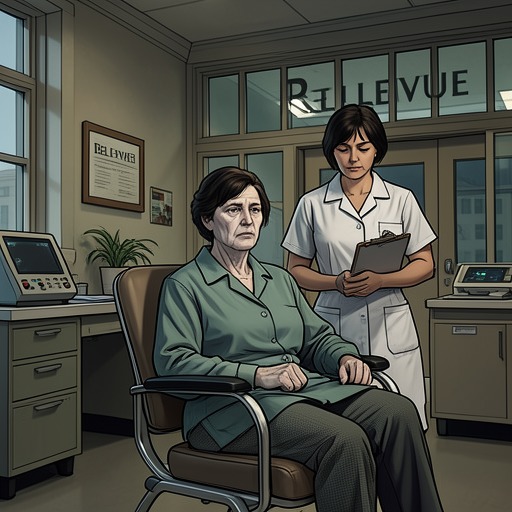
Dr. Harwood
Requiem for a DreamDr. Harwood is the hospital department administrator who sides with Dr. Reynolds against Dr. Spencer’s attempt to change Sara Goldfarb’s treatment. In their confrontation, Harwood makes the department’s smooth operation his overriding responsibility: even if Spencer’s diagnosis is right, Harwood says, the possibility of unnecessary shock treatments matters less than the disruption that challenging a superior might cause. His authority turns a dispute about one patient’s care into a test of what the institution is prepared to protect.
Position and Approach
Harwood supervises the department and has the power to uphold Dr. Reynolds’s treatment decisions over Dr. Spencer’s objections. When Spencer arrives with an urgent complaint, Harwood first asks what the problem is, but notices how rigid Spencer appears and tells him to sit down and relax. The gesture acknowledges Spencer’s visible agitation without conceding the substance of his concern. As the conversation proceeds, Harwood repeatedly treats the disagreement as a conflict between doctors, emphasizing that Reynolds is Spencer’s superior and that Spencer has antagonized him.
Harwood’s manner is controlled. He leans back, frowns, taps his fingertips together, and speaks coolly while Spencer struggles to contain his anger. Those gestures frame the exchange as an administrative proceeding rather than an emergency about a patient: Spencer’s urgency is recast as a disturbance to be managed. Harwood’s initial invitation to explain therefore does not lead to an open review of Sara’s condition. It leads to a defense of the department’s chain of authority.
The Dispute over Sara’s Treatment
Spencer tells Harwood that Sara was admitted in a completely disoriented state and diagnosed by Dr. Reynolds as paranoid schizophrenic, with possible shock treatment recommended. Spencer’s examination, he argues, points instead to a medical problem: Sara had been taking diet pills and Valium and had gone many months without a decent meal. He had ordered her transferred to medical, where rest, proper food, and time for the drugs to leave her system could allow her to recover. Dr. Reynolds countermanded that order and issued standing instructions that Spencer’s orders be ignored immediately.
Harwood does not answer Spencer by assessing Sara’s history or examining the competing treatment plans. He insists that Reynolds has the authority to act and that Spencer cannot interfere with another doctor’s treatment. When Spencer argues that patient welfare requires proper medical attention, Harwood calls his assessment an opinion and stresses that Spencer is challenging a doctor who outranks him and has more experience in psychiatry, a field to which Spencer is hostile. The disagreement over whether Sara belongs in medical or psychiatric care is thus absorbed into a hierarchy of professional rank and departmental jurisdiction.
Spencer offers evidence beyond his judgment: during the preceding eight months, he says, he had taken six of Dr. Reynolds’s patients with the same symptoms and causes, treated them medically, and seen each recover in less than a month without shock treatment or psychotropic drugs. Harwood replies that he knows about these cases, then identifies them as the reason Reynolds gave the orders. The exchange makes clear that Harwood is not simply unaware of Spencer’s experience. He acknowledges it and still treats Reynolds’s restriction of Spencer’s intervention as an acceptable response.
Order over Patient Welfare
The conflict sharpens when Spencer asks whether Harwood approved the treatment without reading Sara’s chart. Harwood confirms that he did not need to see it. Spencer calls the prospect of shock treatment in Sara’s case unnecessary and warns that rest and nourishment could make her well within weeks. Harwood dismisses his language as childish, calls the challenge an anti-Reynolds tirade, and reiterates that Spencer is powerless to override his superior. His response refuses the clinical question at the moment Spencer presses for it most directly: what Sara needs, and what harm the proposed treatment might cause.
Harwood then states the calculation behind his decision. His job, he says, is to make a department in one of the world’s largest hospitals function smoothly, with as little trouble and conflict as possible. He defines his responsibility through the thousands of people who depend on that functioning, not through the needs of one patient. Even if Spencer is right, Harwood considers a few unnecessary shock treatments less damaging than disruption among the staff. The possibility of harm to Sara is not hidden from him; it is explicitly subordinated to institutional calm.
When Spencer asks whether Harwood cares about the patient’s welfare, Harwood tells him not to be naive. He offers no clinical rebuttal to Spencer’s account of the six recoveries and no reconsideration of the chart he has not read. Instead, he advises Spencer that he is free to resign his residency if he disapproves of how the hospital is run. The option is presented as a personal choice, but it leaves the treatment decision and the authority behind it untouched.
Narrative Significance
Harwood’s final maxim, Harmony breeds efficiency, condenses the logic of his position. Harmony here means compliance with rank and the avoidance of internal conflict, not agreement about what would best treat Sara. By treating staff disruption as a greater institutional danger than potentially unnecessary treatment for an individual patient, he gives administrative order precedence over the patient whose case prompted the dispute.
His role also distinguishes two kinds of authority in the scene. Spencer argues from Sara’s condition and from prior patients who, he says, recovered under medical care. Harwood answers from his responsibility for the department and from Dr. Reynolds’s superior status. The result is not a resolution of the medical disagreement but its containment: Spencer leaves, shaken and emptied by the encounter, while Harwood’s decision stands. The scene presents him as an active defender of the hospital’s hierarchy, and shows how that hierarchy can determine a patient’s treatment even when a dissenting doctor believes the decision medically dangerous.